This article navigates the modeling of Concrete Masonry Units (CMUs) following the approach in HERS Addendum 83f.
The columns of cores in CMUs may be filled with insulation, poured with concrete, or left empty. The CMU core fill materials for Pre-Expanded Injectable Foam (FIPI), All Poured (with concrete), and Air Core Fill can be selected as materials under the “CMU Fill” category to fill the Addendum 83f default requirements.
Every property below describes a piece of this cross-section. Picture the wall sliced through one block, looking down from above.
| CMU Size | Nominal CMU depth or thickness (in). Default value is 8 in. |
| CMU Density | Density of the block's concrete, in lb/ft³ (or pcf). Denser concrete conducts more heat, so this is the single biggest driver of how insulating the bare block is. Default value is 115 lb/ft³. |
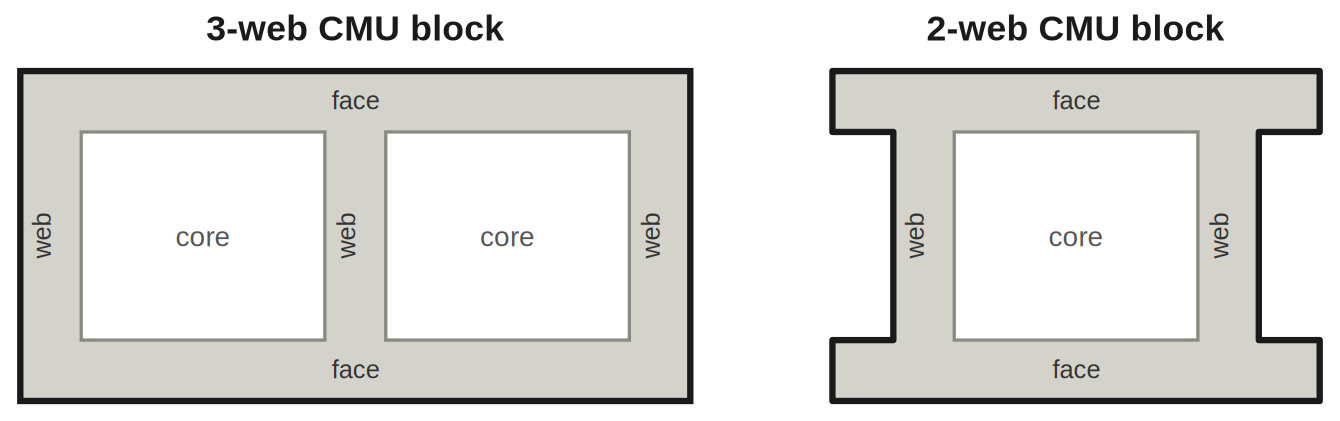
| Webs | Number of solid webs joining the two face shells — 2 or 3. More webs mean more direct concrete paths for heat, and less open core. |
| Webs Thickness | Thickness of each web, in inches. Thicker webs shrink the open core area and add another solid heat path. |
| O.C. Pours | On-center spacing between cores that are filled solid with grout. Enter 0 if none of the cores are poured. Default value is 48 in. |
| Story Height | Height of one story of this wall. Used only to size the horizontal bond beam that RATER assumes runs along the top of the story. Default value is 8 ft. |
Except as expressly documented for the dwelling unit in question, values for 3-web CMU with 115 pound per cubic foot concrete density and core pours at 48” o.c. shall be used.
Core's can be filled or partially filled by material, but the material depth must be less than or equal to the core's depth. Core depth is derived from CMU Size per Addendum 83f as a footnote to equation:
1a: Core Depth = (CMU Size − 0.375 in.) − 2 × 1.25 in
Where 1.25 is the web thickness. For ease of use if the material is poured to fill the cavity the “Full Cavity” radio button can be selected to make the material’s depth track the depth of the CMU’s cavity.
The following picture shows what every input from the former table is: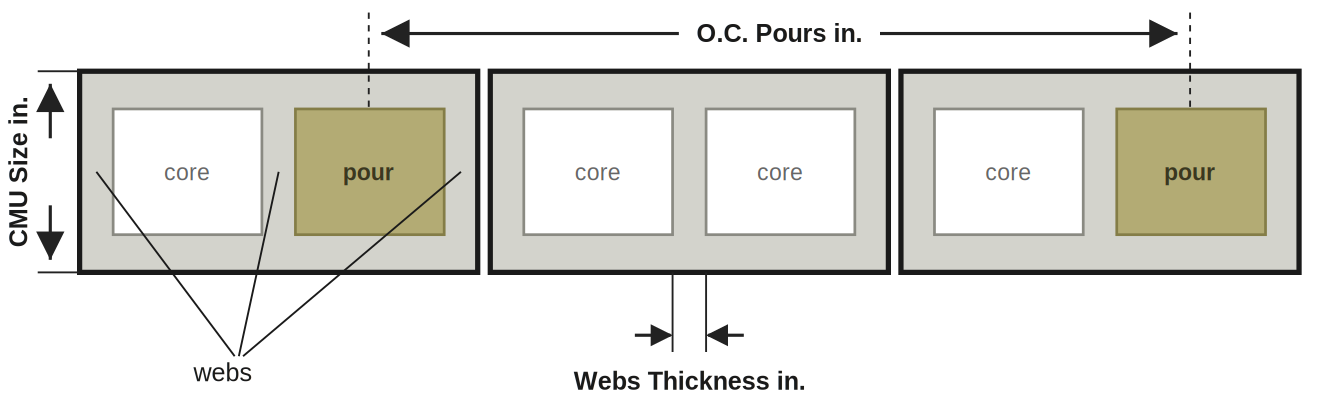
Detail of 3-web and 2-web CMU blocks:
Was this article helpful?
That’s Great!
Thank you for your feedback
Sorry! We couldn't be helpful
Thank you for your feedback
Feedback sent
We appreciate your effort and will try to fix the article