Roof Location Updates
Before the release of the 'Sealed Attic' roof location type in September 2025, the previous options for roof locations were as follows:
| Roof Location Type | Details | HERS/IECC Reference Home |
| Adiabatic Ceiling | Ceilings that separate two conditioned spaces. | Adiabatic Ceiling |
| Exposed Exterior | Roofs that directly separate the conditioned space and the exterior. The roof deck is insulated according to the assembly. | Exposed Exterior |
| Unconditioned Attic | An attic space above the conditioned space. This space has an infiltration aperture of 1 sqft per 300 sqft of roof area. The roof deck is insulated with default R-5, and the attic floor/ceiling is insulated according to the assembly. | Unconditioned Attic |
If a home had a sealed attic, most raters would model their ceiling/roof components with the Exposed Exterior option. But a number of our users were encountering issues with code officials who questioned why a sealed attic space was being modeled with this option, and they requested we add an additional roof location option for this category of spaces. Therefore, we split the Exposed Exterior option into Vaulted Roofs/Exposed Exterior and Sealed Attics.
After the release of Sealed Attics, the roof location options were as follows:
| Roof Location Type | Details | HERS/IECC Reference Home | Previously Modeled As |
| Adiabatic Ceiling | Ceilings that separate two conditioned spaces. | Adiabatic Ceiling | Adiabatic Ceiling |
| Vaulted Roof / Exposed Exterior | Roofs that directly separate the conditioned space and the exterior. The roof deck is insulated according to the assembly. | Vaulted Roof / Exposed Exterior | Exposed Exterior |
| Unconditioned, Vented Attic | An attic space above the conditioned space. This space has an infiltration aperture of 1 sqft per 300 sqft of roof area. The roof deck is insulated with default R-5, and the attic floor/ceiling is insulated according to the assembly. | Unconditioned, Vented Attic | Unconditioned Attic |
| Sealed Attic | An attic space that is conditioned, either directly or indirectly, and has the same infiltration rate as the rest of the thermal envelope. This space should be included in the conditioned volume. The roof deck is insulated according to the assembly, and the ceiling floor is uninsulated. | Unconditioned, Vented Attic | Exposed Exterior |
Adiabatic Ceilings were not changed at all by this update. Vented Attics had their name changed to Unconditioned, Vented Attics, with no algorithm changes. Exposed Exterior had its name changed to Vaulted Roof/Exposed Exterior (VR/EE), again with no algorithm changes.
Sealed Attics receive the exact same roof energy loads as the Exposed Exterior previously, and the Vaulted Roofs currently. If you take a look at the component loads for a home modeled with a VR/EE, and Sealed Attic, you can see that the loads are exactly the same.
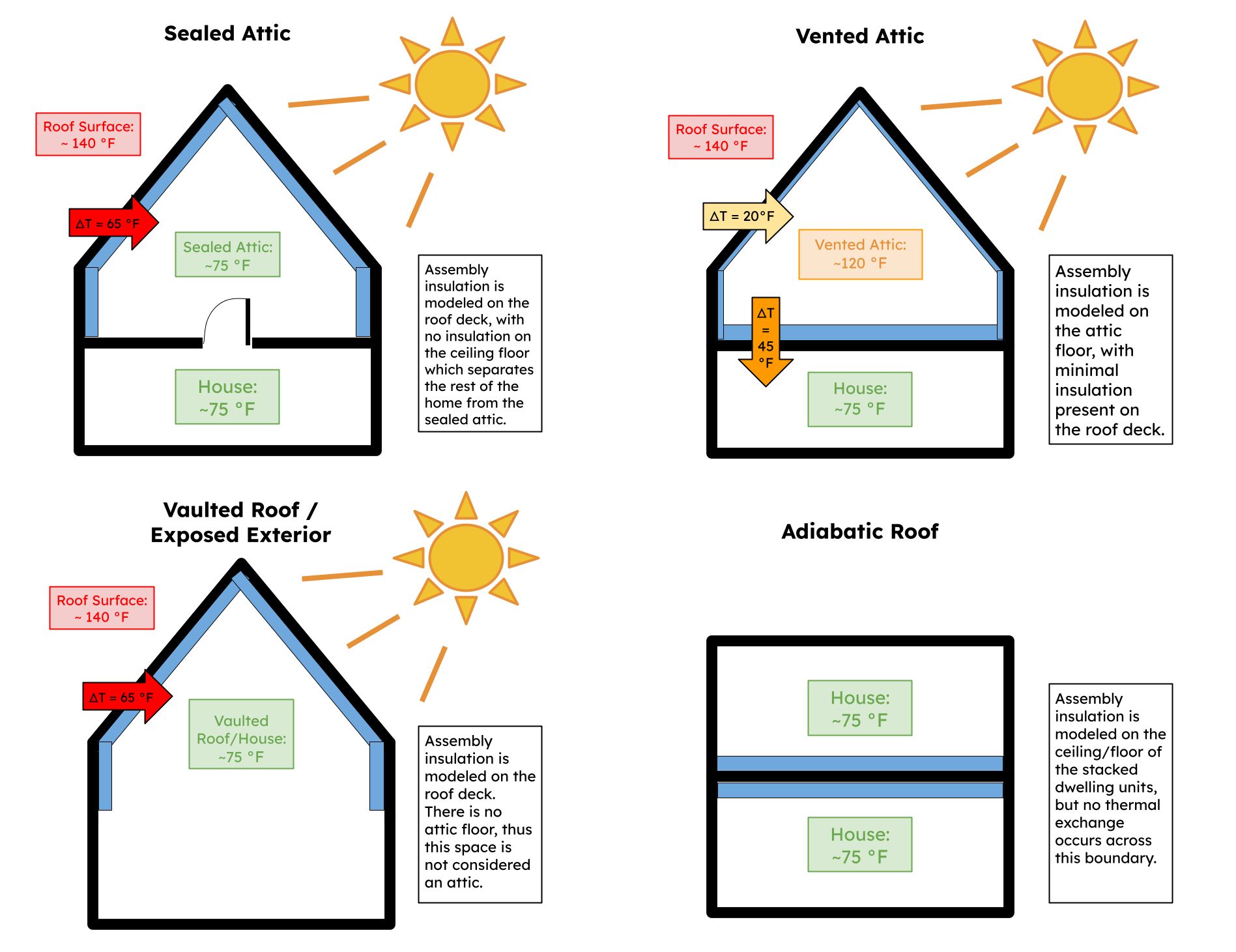
Diagrams of each roof type. The temperatures shown are representative of temperatures seen during the summer in warm climate zones.
Sealed Attic versus Vaulted Roof / Exposed Exterior Performance
You may notice a difference in compliance scores when using a Sealed Attic compared to a VR/EE roof. This is because of the way these two roof locations are treated differently in the reference home. According to the reference home specification in ANSI 301-2022 4.2.2(1), or IECC 2024 R405.4.2(1), if a proposed home has an attic, then the reference home will have an Unconditioned, Vented Attic. The key point is that Sealed Attics count as an attic, so they will be compared against an Unconditioned, Vented Attic, but VR/EE Roofs are not considered an attic, so they will be compared against another Vaulted Roof/Exposed Exterior.
It is our opinion that the space should be considered an attic if it's not livable space. For example, if the ceiling is too low to be made livable, it's likely an attic. If it's potentially livable space, insulated comparably to the rest of the home, and lined with sheetrock on the interior, then it may not be an attic.
Additionally, there are some complications around reference home duct locations when using sealed attics. Sometimes designing the home with a sealed attic allows the ducts to be contained within the conditioned space, which will improve the energy consumption and HERS Index and may offset other roof load calculations. However, Ekotrope currently interprets the IECC codes as specifying the duct location to remain the same in the rated vs. reference homes, so if the rated home ducts are placed in conditioned space, the reference home will also have ducts in conditioned space. Unfortunately this often eliminates IECC compliance credit the home would receive for moving the ducts into conditioned space.
Sealed Attic versus Vented Attic Performance
The performance of a sealed attic in comparison to a vented attic in our model depends on the location of your home and the properties of your roof assembly. In some climates, vented attics perform better than sealed attics in our model. This is because of how the temperature delta across the roof deck in a sealed attic compares to the delta across the attic floor in a vented attic.
For example, during summer in hotter climate zones, the outdoor temperature can reach over 100 degrees Fahrenheit. With incident solar radiation, we can see roof surface temperatures reaching up to 140 degrees in these climates. We calculate vented attic temperatures in these climates at around 120 degrees, as this space stores some heat but also is in constant exchange with the exterior air through the passive ventilation. Across the insulated attic floor, the temperature delta between the vented attic and the conditioned space below, which would be cooling at 75 degrees, would be around 45 degrees (see diagram above).
In comparison, the sealed attic is kept at the same temperature as the conditioned space, so 75 degrees. The temperature delta between the sealed attic and the roof surface, across the insulated roof deck, will be around 65 degrees. The conditioning equipment in your home must work to maintain this temperature difference, so a larger delta means more energy consumption.
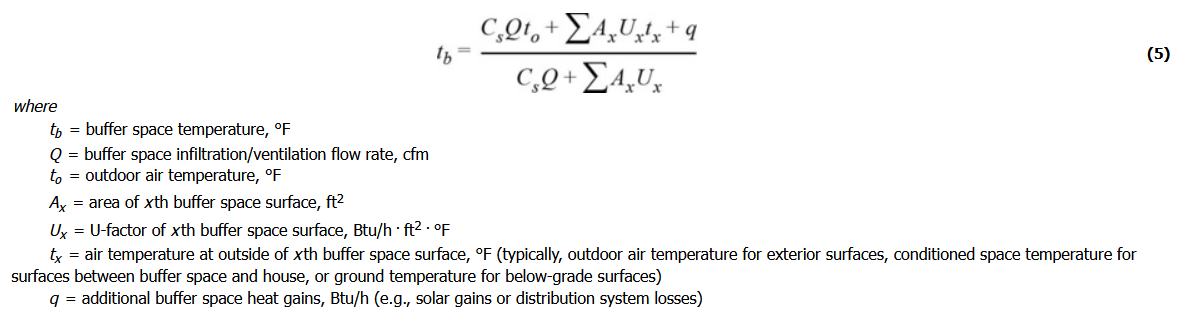
Equation (5) from ASHRAE Book of Fundamentals 2025, Chapter 17 - Adjacent Buffer Spaces
The temperature of our vented attics is calculated in accordance with the ASHRAE Book of Fundamentals. There are additional factors that we don't account for due to calculation time and complexity costs (the q value in this model), and thus our simulation of interior vented attic temperatures might not exactly capture temperatures in these spaces as they are in the field, but this model of attic space temperatures is a widely accepted, functional approach. Even with the limitations of this model, we have been continually able to meet increasingly stringent RESNET accreditation tests found in Publication 002, and the accuracy of our energy calculations has only continued to increase.
Was this article helpful?
That’s Great!
Thank you for your feedback
Sorry! We couldn't be helpful
Thank you for your feedback
Feedback sent
We appreciate your effort and will try to fix the article